As a faculty member in Regis University’s Master of Science in Data Science program, I kept seeing the same frustrating pattern. Smart students with impressive projects would graduate, then struggle for months to find jobs that matched their skills. The problem wasn’t their abilities. It was how they presented themselves. Most had scattered GitHub repositories, basic LinkedIn profiles, and maybe a personal website thrown together at the last minute. Recruiters couldn’t easily see how their skills had grown or how their coursework connected to real jobs. So I built RegisPortfolio.com.
Great projects, hard to find
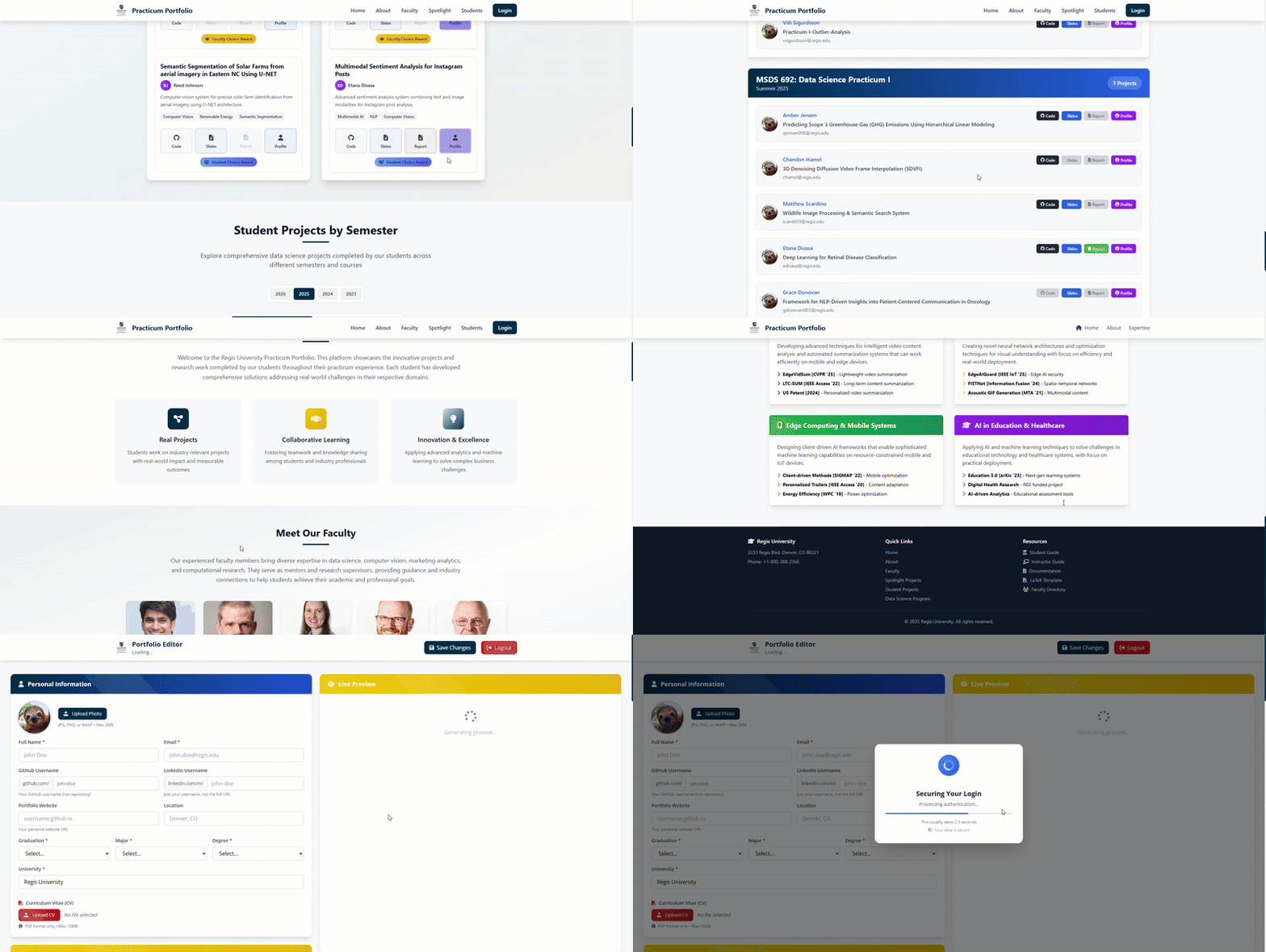
Some examples from our MSDS students:
- Matthew Scardino built a “Wildlife Image Processing & Semantic Search System V2” that won a Faculty Choice Award. It identifies species using multiple models and integrates MCP and LangGraph.
- Chandon Hamel won a Faculty Choice Award in Summer 2025 for “3D Denoising Diffusion Video Frame Interpolation,” which uses 3D diffusion models to generate in-between video frames.
- Etana Disasa won a Student Choice Award for “Multimodal Sentiment Analysis for Instagram Posts,” which combines text and images to judge sentiment.
Before RegisPortfolio, work like this was easy to miss. The pattern was the same every semester:
- Students are strong at the technical work but have never had to present it professionally.
- Good projects get buried in messy GitHub repositories.
- Every student builds a portfolio differently, and many don’t build one at all.
- Recruiters can’t see how a student progressed through the program, or how a class project relates to the job they’re hiring for.
Demo
How it works for students
The idea behind RegisPortfolio.com is simple: the best portfolios tell a story, not just list projects.
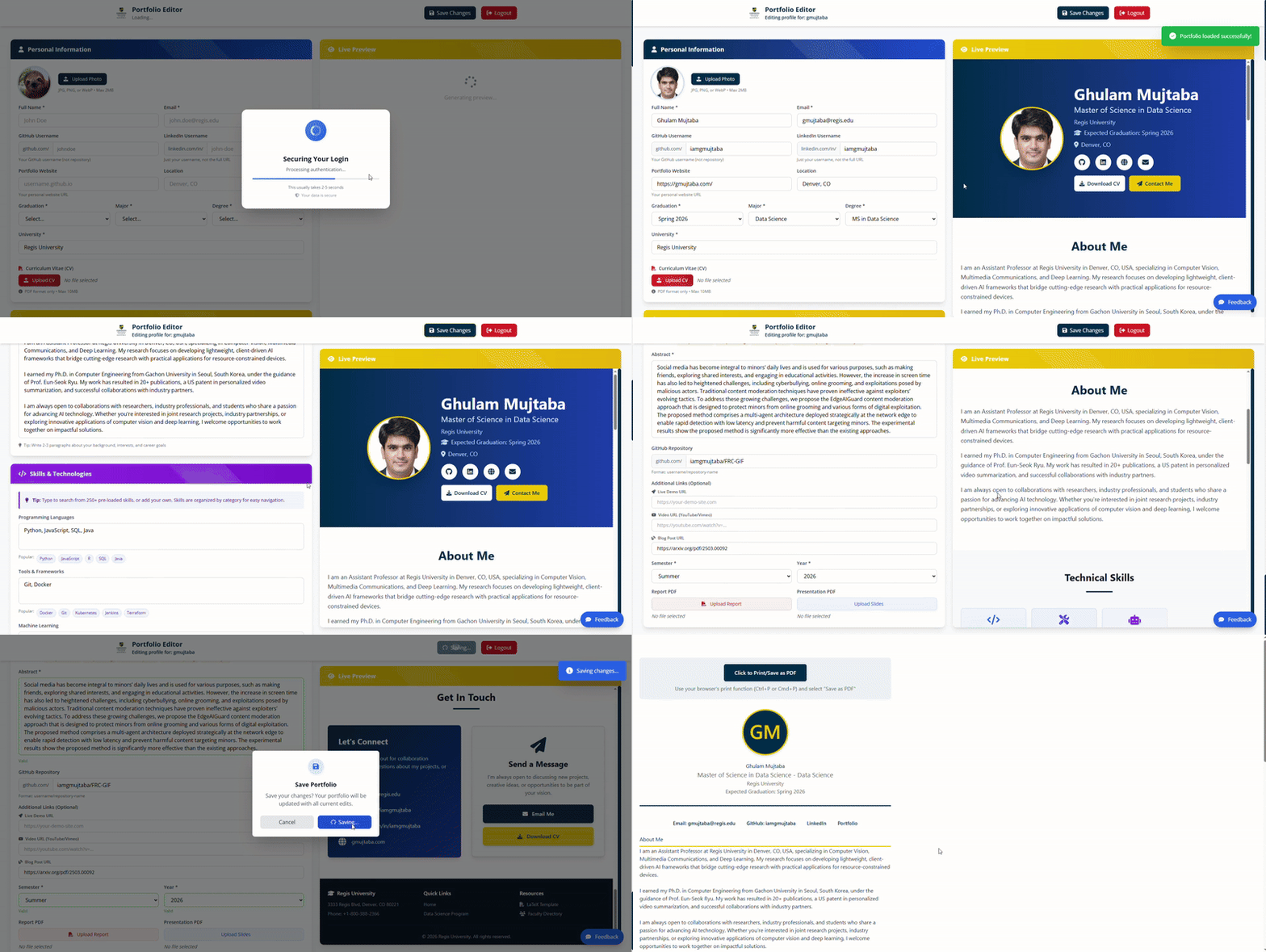
Students use the portfolio editor to add projects straight from their coursework. They don’t need to know HTML, CSS, or web development. For each project they write a short reflection connecting it to their career goals, preview exactly what a recruiter will see, and build up a record of their progress semester by semester.
Under the hood
Why serverless
Student usage is spiky: heavy at the end of each term, quiet in between. Paying for a server that sits idle most of the year doesn’t make sense. With a serverless setup:
- there’s no server to maintain, and nothing to go down during job search season,
- it scales automatically when everyone submits at the end of the term,
- costs follow usage, which keeps it affordable for a university,
- a content delivery network (CDN) serves portfolios quickly to recruiters anywhere.
Students own their accounts
Students sign in with GitHub (OAuth), so each portfolio belongs to the student, not to a university account. They can choose which projects are visible, edit from any device, and keep access after their university email expires.
Mobile first
Recruiters often look at portfolios on their phones, so every page is designed for small screens first and still works well on a desktop.
Version control and automatic deployment
All portfolio content lives in Git, which gives a full history and a backup of every change. When a student saves in the editor, GitHub Actions rebuilds and publishes their public page, usually in under 30 seconds.
Key features
- Standard forms, professional pages: students fill in their project details, and the platform generates consistent, well-designed portfolio pages.
- Responsive design: pages work on phones, tablets, and desktops.
- Built-in SEO: every page has meta tags and structured data, so portfolios show up in search.
- Fast everywhere: pages are served through a global CDN.
Example: my profile on RegisPortfolio.
What’s next
AI features
- Automatically categorizing projects and extracting skills, so students type less.
- Suggesting career paths and job openings based on a student’s projects.
- Recommending classmates with complementary skills for team projects.
Alumni
- Letting graduates keep updating their portfolios after they finish the program.
- Tracking career outcomes over time, which helps the program and shows current students realistic paths.
- Connecting current students with alumni working in the industries they’re targeting.
Want this for your program?
RegisPortfolio gives our students one professional place to show their work, and it helps employers see what our graduates can do. If you’d like to talk about the architecture, adapting it for your institution, or collaborating on an open-source version, email me at gmujtaba@ieee.org.
See it live: browse student portfolios at RegisPortfolio.com, try the editor at editor.regisportfolio.com, or connect with me on LinkedIn.